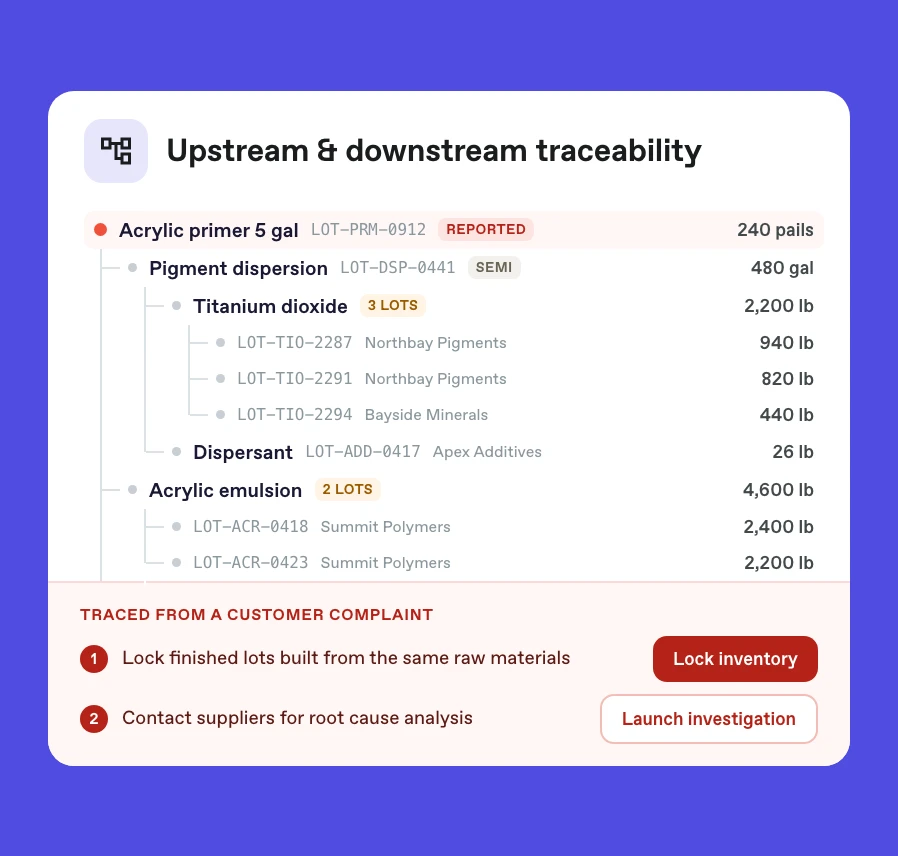
Process manufacturing ERP — often called batch manufacturing ERP — runs production from formulas and recipes rather than bills of materials. The right system manages batch genealogy, potency and yield variability, co-products and by-products, shelf-life, and regulatory compliance for chemical, coatings, food, and specialty makers.
10 systems ranked12 buyer questions answeredLast updated August 2026
Sponsored · Process manufacturing ERPPaid placement
Built for small and mid-market manufacturers, Bonx centralizes and connects your operations so that AI can handle more of the routine. 2x–4x your existing team capacity with manufacturing software your team will actually love.
✓Every manufacturing ERP module you need in one connected system: sales, purchasing, production, quality, logistics, inventory, and invoicing.
✓Connects to anything else in your stack, from tools and systems to machines, hardware, and more.
✓Built-in intelligence gets smarter and more capable of taking on routine work over time.
10+ ERP systems evaluated for Process Manufacturing. Compare side by side, estimate cost, find an implementation partner, or download the Top 10 report.
The best process manufacturing ERP systems in 2026 are BatchMaster ERP, Deacom ERP, and Sage X3.BatchMaster ERP is the strongest fit for process manufacturers in food, pharma, and chemical industries; Deacom ERP for process and batch manufacturers in food, chemical, and pharma industries; and Sage X3 for midsize process manufacturers and distributors. The full ranking below compares 10 systems on pricing, implementation timelines, and process manufacturing-specific capabilities, drawing on verified deployments from our benchmark dataset.
Top 10 Process Manufacturing ERP Systems Compared (2026)
The best process manufacturing ERP systems, ranked by fit — with pricing, timelines, product screenshots and action links for every system.
Cloud · On-Premise|Best for process manufacturers in food, pharma, and chemical industries
In process manufacturing, BatchMaster fits small to mid-size formulators — chemicals, coatings, nutraceuticals, personal care — that live in formulas rather than BOMs and need compliance built in, not bolted on. Formula management with version control and automatic scaling, potency-adjusted batch sizing, lot genealogy in both directions, and SDS/GHS documentation are the product's core, and it deploys standalone or embedded inside SAP Business One and Sage financials. The ceiling is architectural: multi-plant enterprises and heavy-distribution operations stretch past what a formulation-first mid-market product is built for.
Strength: Strong formulation/recipe management with R&D lab tools
Process Manufacturing features
Formula versioning with automatic batch scaling and sizing · Potency and concentration adjustment against actual assay values · Forward and backward lot genealogy for recall response · SDS authoring and GHS-compliant labeling output · Deployment embedded with SAP Business One or Sage financials
Cloud · On-Premise|Best for process and batch manufacturers in food, chemical, and pharma industries
In process manufacturing, Deacom ERP suits mid-size batch producers that want one system covering formulation, production, quality, and even WMS and e-commerce — its single-codebase philosophy exists specifically to avoid the integration seams where batch data gets lost. Lot genealogy, QC holds tied to batch release, tank and vessel scheduling, and co-product costing are native, and yield variance is tracked batch by batch. The philosophy cuts both ways: if Deacom lacks a capability there is no ISV ecosystem to fill it, and you adapt to the product's way of working.
Strength: Single-system architecture — no bolt-on integrations needed
Process Manufacturing features
Single-codebase coverage from formulation through WMS · QC holds and dispositions gating batch release · Tank, vessel, and finite resource batch scheduling · Co-product and by-product cost allocation · Batch-level yield and variance reconciliation
Cloud · On-Premise|Best for midsize process manufacturers and distributors
In process manufacturing, Sage X3 fits mid-market batch producers running multiple sites, currencies, or countries — the segment where pure formulation specialists get thin and tier-1 suites get expensive. It carries genuine process depth for a broad suite: formula and recipe management with versioned technical data, by-product and co-product yield handling, quality control points at receipt and in production, and multi-site MRP. The trade-off is being between stools — deeper than generalist cloud ERPs on process work, but lighter than BatchMaster or Deacom on formulation edge cases, with an interface that shows its age.
Strength: Excellent for process manufacturing (batch, formula, compliance)
Process Manufacturing features
Formula management with versioned technical data sheets · By-product and co-product yield and cost handling · Multi-site, multi-currency MRP for international operations · Quality control points at receipt, in-process, and release · Batch traceability with expiry and reassessment dating
Cloud|Best for small and mid-market manufacturers (50–1,000 employees) that want an AI-native manufacturing ERP
Bonx is the AI-native manufacturing ERP: it runs the operational side of the business — sales orders, purchasing, planning and scheduling (including MRP), production, quality, logistics and stock with lot and serial traceability — and invoices natively while leaving the general ledger to your accounting tool. Deployments are phased and average 10 weeks; workflows are configured by the customer rather than by consultants, and AI agents handle routine decisions and surface exceptions. 80+ manufacturers run on it.
Strength: Fast, consultant-free deployment with floor-first UX and built-in AI agents
Process Manufacturing features
Manufacturing orders, work instructions and floor declarations · Planning and scheduling against live demand, capacity and materials · Quality checks at receipt, in-process and pre-shipment with batch holds · Multi-site stock with lots, serials and units of measure · Native invoicing with e-invoicing and accounting sync
Used in process manufacturing byFrench BloomSomethingAddedWed'ze (Decathlon)GreenPodsSo-Le Studio
Sponsored listing · Bonx is a paying sponsor of ERP Research. The numbered editorial ranking is not affected.
Cloud · On-Premise|Best for process manufacturers (food, chemicals, pharma) needing batch/formula control
In process manufacturing, Infor M3 is the CloudSuite backbone for mid-size to large chemicals, food, and beverage producers whose products vary by attribute — grade, concentration, pack size — rather than existing as single fixed SKUs. Attribute-based inventory, catch-weight-style flows, multi-site planning that blends manufacturing and distribution, and industry compliance packs come from decades of process-industry focus. M3 assumes scale: implementation runs through Infor and its partner channel at enterprise pace, and smaller single-site processors will find it more platform than they need.
Strength: Excellent batch management, formula control, and traceability
Process Manufacturing features
Attribute-managed inventory for grade and concentration variants · Multi-site planning across production and distribution networks · Batch balancing and reservation by attribute matching · Industry compliance packs for regulated process sectors · Yield and shrinkage tracking through production stages
Cloud · On-Premise|Best for chemical, coatings, and adhesive manufacturers needing regulatory compliance
In process manufacturing, Datacor ERP is purpose-built for chemical manufacturers and distributors — the vendor's entire business is the chemical vertical, and it shows in what ships standard. Regulatory documentation (SDS authoring, GHS labels, TSCA and REACH tracking), formula security, lot traceability, and chemical-specific pricing structures like index-based and freight-inclusive pricing are native rather than configured. That focus is the constraint: outside chemicals, coatings, and adhesives the fit drops off quickly, and companies diversifying into other process sectors will find the vertical assumptions baked in.
Strength: Purpose-built for chemical and process manufacturing
Process Manufacturing features
SDS authoring and revision management in the core product · TSCA, REACH, and state-level chemical regulatory tracking · Formula security with role-restricted recipe access · Chemical pricing structures including index-based contracts · Lot traceability spanning manufacturing and distribution sides
Cloud · On-Premise|Best for food, beverage, and industrial manufacturers needing industry-specific ERP
In process manufacturing, Aptean's process editions (the Ross ERP lineage) fit mid-size batch producers in food, beverage, and chemicals that need mature formula-based production with the resources of a large vertical-software group behind it. Recipe management with nutrient and attribute rollups, batch scheduling, lot genealogy, and compliance documentation reflect decades of process-industry installations. The portfolio is the caveat: Aptean sells many acquired ERPs under one brand, so buyers must verify which specific product and edition is being proposed and how actively it is developed.
Strength: Deep industry-specific functionality for food & beverage
Process Manufacturing features
Recipe management with nutrient and attribute rollups · Batch production scheduling against line and tank capacity · Lot genealogy with rapid mock-recall execution · Compliance documentation for audited process environments · Yield accounting from raw intake through finished pack
Cloud · Hybrid|Best for large, complex enterprises needing deep customisation and controlled upgrades
In process manufacturing, SAP S/4HANA Private Cloud serves large multi-plant producers — specialty chemicals, industrial gases, consumer products — that need recipe-based production integrated with global supply chain, EHS, and financial consolidation in one system. Process orders with phase-level control recipes, batch management with full genealogy, co- and by-product settlement, and embedded EHS compliance are deep and battle-tested. The cost of that depth is total weight: multi-year implementations, specialist skills, and a price point that only multi-site enterprises can justify against the alternatives.
Strength: Full custom ABAP development — bring existing ECC customisations
Process Manufacturing features
Process orders with phase and control-recipe execution · Batch management with cross-plant genealogy · Co-product and by-product settlement in costing · Embedded EHS for dangerous-goods and emissions compliance · Recipe development integrated with plant-level master recipes
Cloud · Hybrid|Best for mid-to-large companies in the Microsoft ecosystem
In process manufacturing, Microsoft Dynamics 365 Supply Chain Management fits mid-size to large batch producers on the Microsoft stack whose needs center on formula-based planning and costing more than deep plant execution. Formula and co-product BOM types, potency-based pricing and consumption, catch-weight handling, and batch order management are in the core, which surprises buyers who assume Dynamics is discrete-only. Depth stops short of the specialists: electronic batch records, tank scheduling, and regulatory documentation typically come from ISVs, adding a second vendor relationship to manage.
Strength: Seamless integration with Microsoft 365, Teams, and Power BI
Process Manufacturing features
Formula BOMs with co-product and by-product lines · Potency-based material consumption and pricing · Catch-weight inventory in dual units of measure · Batch orders with lot inheritance and shelf-life dating · ISV ecosystem supplying batch records and tank scheduling
Cloud · On-Premise|Best for sMB manufacturers and distributors in 50–500 employee range
In process manufacturing, SYSPRO fits mixed-mode producers — companies that blend, coat, or formulate materials and then assemble or pack them discretely — where a pure formulation specialist would strand the discrete half of the business. It handles recipe-style BOMs, lot traceability with expiry control, scrap and yield factors, and quality holds within the same mid-market system that runs its well-regarded discrete MRP. Pure-play batch processors should note the emphasis: process capability is an extension of a discrete-rooted architecture, not a formulation-first engine with potency management at its core.
Strength: Strong manufacturing and distribution focus at an affordable price
Process Manufacturing features
Mixed-mode production combining batch and discrete stages · Recipe-style BOMs with scrap and yield factors · Lot traceability with expiry and shelf-life control · Quality holds and dispositions on batch output · Single system spanning formulation and downstream assembly
Cloud · On-Premise · Hybrid|Best for midsize companies wanting unlimited users and flexible cloud ERP
In process manufacturing, Acumatica suits smaller batch producers whose requirements are moderate — recipe management, lot control, expiry dating — and who value the platform's consumption-based licensing and open API over deep formulation science. Native manufacturing covers batch-style production orders and lot traceability, and process-specialist ISVs on the marketplace layer in formulation, compliance, and quality depth where needed. That layering is the trade-off: regulated or formulation-intensive operations end up depending on the ISV as much as on Acumatica itself, which complicates support and upgrades.
Strength: Unlimited users — resource-based pricing is unique and cost-effective
Process Manufacturing features
Batch-style production orders with lot and expiry control · Marketplace ISVs adding formulation and compliance depth · Consumption-based licensing for seasonal production staff · Open API connecting lab and quality systems · Combined distribution and light-process operations in one tenant
39 ERP vendors evaluated for this guide·Independent — vendors do not pay for ranking or preview it·Reviewed annually with quarterly touch-ups
How we rank these ERPs — our editorial methodology▾
Rankings on this page are editorial, not paid. Vendors do not pay for position, nor do they preview rankings before publication. Every shortlisted system is evaluated on a published 7-pillar framework:
30%Functional depth
20%Total cost of ownership
15%Implementation risk
10%Ecosystem strength
10%Roadmap & AI investment
10%Customer experience
5%Vertical / industry fit
Rankings are reviewed annually with quarterly touch-ups for material changes (new releases, acquisitions, reference drift). Read the full methodology →
Top 10Manufacturing ERP 2026 Edition
Get the Top 10 Manufacturing ERP Report
Free 2026 PDF · 30 pages · the full rankings, pricing benchmarks and RFP checklists for manufacturing buyers.
Used by operations-led manufacturers and distributors such as VersaCourt, On Foot Innovations, and No.1 Raw Materials
Bonx
Bonx
Small and mid-market manufacturers (50–1,000 employees) in process, food & beverage, textile and jewellery production that want an operational ERP live in weeks, configured without consultants
What is the difference between process manufacturing and discrete manufacturing ERP?
Process manufacturing ERP uses formulas and recipes instead of bills of materials, manages batch-oriented production rather than work orders, handles variable yield and potency calculations, and supports co-product/by-product accounting. Discrete ERP focuses on assemblies, routings, and countable units.
Can a discrete manufacturing ERP be used for process manufacturing?
Not effectively. Process manufacturing requires formula management, potency tracking, batch genealogy, yield calculations, and regulatory capabilities that discrete ERP systems do not support natively. Using a discrete ERP for process operations leads to workarounds, compliance gaps, and inaccurate costing.
How does ERP handle potency and grade variations in raw materials?
Process manufacturing ERPs adjust recipe quantities based on actual potency or concentration of incoming raw materials. For example, if a batch of an active ingredient tests at 95% potency instead of 100%, the system automatically recalculates the required quantity to maintain the target finished-goods specification.
What regulatory compliance features should I expect?
Look for safety data sheet (SDS) management, REACH and GHS compliance tracking, certificate of analysis generation, environmental reporting (EPA, VOC tracking), allergen management (for food), electronic batch records with audit trails, and 21 CFR Part 11 support for regulated industries.
How do process manufacturing ERPs handle batch costing?
They allocate raw material, labor, overhead, and energy costs to each batch based on actual consumption. Co-products and by-products receive cost allocation using configurable methods (weight, volume, market value, or manual split). Yield variances are captured and analyzed by batch, product, and production line.
Is LIMS integration important for process manufacturers?
Yes. LIMS (Laboratory Information Management System) integration automates quality testing workflows by passing batch samples to the lab, receiving test results back into the ERP, and automatically releasing or quarantining batches based on specification compliance. This eliminates manual data entry and reduces release cycle times.
What is the biggest implementation risk for process manufacturers?
Underestimating the complexity of formula and recipe data migration. Process manufacturers often have thousands of formulas with version history, potency adjustments, and regulatory documentation that must be migrated accurately. Poor data migration leads to incorrect batch sizing, costing errors, and compliance failures.
Can one ERP handle both process and discrete manufacturing?
Some ERPs support mixed-mode manufacturing. Infor LN, SAP S/4HANA, and Microsoft Dynamics 365 can run process and discrete operations in a single instance. For companies that primarily do process manufacturing, however, a purpose-built process ERP often provides deeper functionality and better fit.
Who offers specialized ERP for batch-oriented manufacturers?
The specialist batch manufacturing ERP vendors are BatchMaster, Deacom (ECI), Aptean Process Manufacturing ERP (Ross Edition), Datacor, and ProcessPro — all built around formulas, batch tickets, and lot genealogy rather than bills of materials. Sage X3, Infor CloudSuite, and SYSPRO cover batch production within broader suites, and SAP S/4HANA, Oracle Cloud ERP, Infor LN, and Dynamics 365 Supply Chain Management serve enterprise batch operations.
Is batch manufacturing ERP the same as process manufacturing ERP?
In practice buyers use the terms interchangeably, and vendors sell the same products under both labels. Strictly, batch manufacturing is one mode of process manufacturing — production in discrete, finite lots against a recipe — while process manufacturing also covers continuous production such as refining or extrusion. If you make product in batches against a formula, batch manufacturing ERP and process manufacturing ERP shortlists will look almost identical.
Should batch manufacturers pick a specialist ERP or a tier-1 suite?
Choose a specialist such as BatchMaster, Deacom, or Aptean when formulation depth, lot genealogy, and compliance are the core requirement and you run a single site or a small group of sites. Choose a tier-1 suite such as SAP S/4HANA, Oracle Cloud ERP, or Dynamics 365 when multi-entity finance, global supply chain, and corporate reporting outweigh formulation depth, and you have the budget and internal IT to run it.
What is the best ERP for chemical manufacturing and distribution?
Large global chemical manufacturers typically choose SAP S/4HANA, whose PP-PI (Production Planning for Process Industries) engine handles recipe management and co-product/by-product yields alongside SAP EHS Management for REACH registration and hazardous-substance tracking. Mid-market process makers favour Aptean, Infor CloudSuite, or Microsoft Dynamics 365, and formulators and distributors often select purpose-built systems like Datacor or BatchMaster for native formulation, SDS authoring, and lot genealogy. Chemical distributors have different priorities — repackaging, container management, and catch-weight billing — so they often shortlist distribution-oriented systems rather than heavy manufacturing ERP. Cloud pricing for SMB chemical firms typically starts around $100–$180 per user per month.