
SAP for Small Business Guide
Is SAP good for small business? Compare SAP Business One, Business ByDesign and Grow with SAP - pricing, implementation timelines and when to choose an alternative.
Updated July 2026.
Yes, SAP serves small businesses. Its dedicated SMB product is SAP Business One, an on-premise or cloud ERP built for firms of roughly 10 to 500 employees, while SAP Business ByDesign and the newer Grow with SAP public-cloud offering suit growing mid-market companies that need more advanced, scalable functionality.
SAP is best known for running the world's largest enterprises, so many owners assume it is out of reach. In practice, SAP maintains a separate small-business portfolio with lighter deployments, faster timelines, and pricing designed for smaller teams. This guide breaks down each product, what it costs, how long implementation takes, and when a small business is better served by an ERP for small business alternative.
Does SAP have a product for small businesses?
SAP does not sell its flagship S/4HANA enterprise suite to most small businesses. Instead, it offers three routes into the small and mid-market, each aimed at a different stage of growth:
- SAP Business One - the core small business ERP for companies of roughly 10 to 500 employees that need accounting, inventory, purchasing, CRM, and light manufacturing in one system. Sold and implemented through SAP partners.
- SAP Business ByDesign - a cloud ERP for mid-sized and multi-entity businesses (often 100 to 1,000 employees) that need advanced financials, supply chain, project management, and built-in analytics.
- Grow with SAP - a packaged offering that brings public-cloud SAP S/4HANA Cloud to growing mid-market firms, using pre-configured best-practice processes to speed up go-live.
For most true small businesses, the decision starts and ends with SAP Business One. ByDesign and Grow with SAP become relevant as headcount, entities, and process complexity grow.
SAP Business One: the core small business ERP

SAP Business One is the product SAP purpose-built for small to medium-sized businesses. It runs on-premise or in the cloud and covers the core operational areas a growing company needs in a single database:
- Accounting and finance - general ledger, accounts payable and receivable, financial reporting, and budgeting.
- Inventory management - real-time stock levels, purchase order management, and warehouse control to reduce stockouts.
- Purchasing - purchase orders and vendor management to control costs and supplier relationships.
- CRM - sales order management, customer records, and basic marketing and service tracking.
- Production planning - bill of materials (BOM) and production order management for light manufacturers.
SAP Business One pricing. Business One is typically bought as a one-time perpetual license plus an annual maintenance fee, though subscription options exist. Perpetual license fees generally range from $3,000 to $10,000 per named user, depending on whether the user is a full Professional user or a Limited user, and the annual maintenance fee is around 18% of the license cost. On top of licensing you pay for implementation, hosting or hardware, and any add-ons. Our full SAP Business One pricing guide breaks the tiers down further.
SAP Business ByDesign and Grow with SAP for growing companies
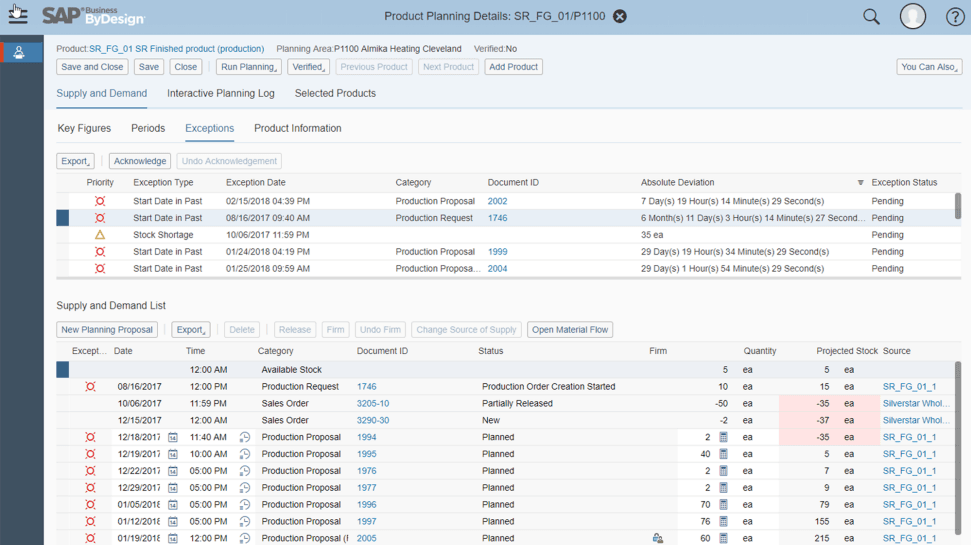
Once a business outgrows Business One - more entities, tighter reporting requirements, or complex supply chains - SAP points buyers toward its cloud products.
SAP Business ByDesign is a fully cloud-hosted ERP aimed at mid-sized and fast-growing companies. It adds advanced financial management, supply chain and demand planning, project management with time and expense tracking, HR and payroll, and real-time analytics. ByDesign is sold as a subscription: the fee typically runs $150 to $200 per user per month, with a minimum of around 10 users, so it starts at a meaningfully higher commitment than Business One. See our SAP Business ByDesign overview for the full feature and pricing picture.
Grow with SAP is SAP's more recent packaged route to public-cloud S/4HANA for the mid-market. It bundles the software, pre-configured industry best practices, adoption tooling, and a community to accelerate a standardized go-live. It suits growth-stage companies that want the S/4HANA platform without a heavy, custom enterprise implementation - but it is generally more system than a 20-person business needs.
Get a free personalised ERP shortlist
Tell us your industry and company size and we'll recommend the best-fit vendors.
How much does SAP cost for a small business?
Total cost of ownership for SAP in a small business is more than the license sticker price. Budget for three buckets:
- Software - Business One perpetual licenses at roughly $3,000-$10,000 per user plus 18% annual maintenance, or ByDesign at $150-$200 per user per month.
- Implementation - partner services for configuration, data migration, integration, and training. As a rule of thumb, ERP implementation runs about 1% to 2% of annual revenue for a small business, though smaller Business One projects often land below that range.
- Ongoing - hosting (for cloud), support, add-ons, and periodic upgrades.
A lean SAP Business One deployment for a small company frequently lands in the low-to-mid five figures all-in for year one, while ByDesign and Grow with SAP scale higher with user count and complexity.
How long does SAP take to implement for a small business?
A focused SAP Business One implementation for a small business typically takes around three months from kickoff to go-live, assuming clean data and standard processes. Simple deployments can go faster; multi-entity, heavily customized, or manufacturing-intensive rollouts take longer.
The main drivers of timeline are the quality of your data migration, how much customization you request, integration with existing systems, and user training. Working with an experienced partner and following a proven SAP Business One implementation methodology is the single biggest factor in staying on schedule. Cloud products like ByDesign and Grow with SAP can shorten setup because there is no hardware to provision and they ship with pre-configured best practices.
SAP Business One vs Business ByDesign vs Grow with SAP
| SAP Business One | SAP Business ByDesign | Grow with SAP | |
|---|---|---|---|
| Best for | Small businesses, ~10-500 employees | Mid-sized / multi-entity, ~100-1,000 employees | Growth-stage mid-market wanting S/4HANA |
| Deployment | On-premise or cloud | Cloud only | Public cloud (S/4HANA Cloud) |
| Pricing model | Perpetual license + 18% maintenance (or subscription) | Subscription, ~$150-$200/user/mo, ~10-user min | Subscription bundle |
| Strengths | Cost-effective, light manufacturing, distribution | Advanced financials, supply chain, analytics, projects | Standardized best practices, fast go-live, scalable platform |
| Typical timeline | ~3 months | 3-6 months | 3-6 months |
For most small businesses the honest answer is Business One. Move up to ByDesign or Grow with SAP when you have multiple legal entities, international operations, or reporting needs that Business One cannot handle cleanly.
When does SAP make sense for an SMB (and when should you look elsewhere)?
SAP is a strong fit for a small business when you:
- Run inventory, distribution, or light manufacturing and need real operational control, not just accounting.
- Expect to grow and want a vendor with a clear upgrade path from small business to enterprise.
- Value a large global partner network and a mature, well-supported product.
SAP may be overkill - and a lighter or more modern cloud ERP a better fit - when you are a services or software business with simple operations, a very small team, or a tight budget and timeline. In those cases it is worth comparing SAP against:
Microsoft Dynamics 365
A modular cloud ERP and CRM suite that scales from small business to enterprise, with strong Microsoft 365 integration.
Oracle NetSuite
A cloud-native ERP popular with fast-growing small and mid-sized companies, especially in software, services, and multi-entity finance.
Sage Intacct
A cloud financial management platform strong in accounting, project accounting, and revenue recognition for services businesses.
Infor CloudSuite
Industry-specific cloud ERP with deep functionality for manufacturing and distribution.
The best way to decide is to score each option against your actual requirements rather than the marketing. Building a structured requirements list first - covering the processes, modules, and integrations you truly need - keeps the comparison objective.
Frequently Asked Questions
Is SAP good for small businesses?
Yes. SAP Business One is purpose-built for small businesses of roughly 10 to 500 employees, offering accounting, inventory, purchasing, CRM, and light manufacturing in one system. Larger or faster-growing SMBs can move up to SAP Business ByDesign or Grow with SAP. The main trade-offs are cost and implementation effort versus lighter cloud alternatives.
Which SAP product is best for a small business?
For most small businesses, SAP Business One is the right product - it is the cheapest to run and covers core operations. SAP Business ByDesign and Grow with SAP are better suited to mid-sized companies with multiple entities, international operations, or advanced supply chain and analytics needs.
How much does SAP Business One cost?
SAP Business One perpetual licenses typically cost $3,000 to $10,000 per user depending on whether it is a full Professional or Limited user, plus an annual maintenance fee of about 18% of the license cost. You also pay for implementation, hosting or hardware, and any add-ons, so budget beyond the license alone.
How long does it take to implement SAP for a small business?
A standard SAP Business One implementation for a small business takes around three months from kickoff to go-live. Timelines stretch with more customization, multiple entities, complex data migration, or manufacturing requirements, and shorten for clean, standardized deployments.
What is the difference between SAP Business One and SAP S/4HANA?
SAP Business One is a self-contained ERP for small businesses, while S/4HANA is SAP's enterprise suite for large organizations. Grow with SAP is the packaged route that brings public-cloud S/4HANA to growing mid-market companies without a full enterprise-scale project.
Is SAP Business One cloud or on-premise?
SAP Business One can be deployed either on-premise on your own hardware or hosted in the cloud through an SAP partner. SAP Business ByDesign and Grow with SAP, by contrast, are cloud-only offerings.
Further Reading
Compare the vendors mentioned in this article
See how SAP Business One, SAP Business ByDesign, Oracle NetSuite, Microsoft Dynamics 365 stack up side by side.
Further Reading
SAP for Small Business Guide
Is SAP good for small business? Compare SAP Business One, Business ByDesign and Grow with SAP - pricing, implementation timelines and when to choose an alternative.
Blog8 Best Cloud ERP Systems for Small Business, Ranked (2026)
Best ERP software for small business and SMB 2026. Compare Top SaaS ERP systems vendors for SME and small medium enterprises businesses.
BlogWhat is the best ERP for FinTech? Best Fintech ERP Systems 2026
Compare the best ERP for fintech companies in 2026 — vendor shortlist, cost by company size, and the PCI DSS, SOC 2 and ASC 606 requirements that matter.
See Pricing
ERP Benchmark: Which Vendors Do Companies Actually Choose?
See real-world vendor adoption data for your industry — 23,000+ tracked implementations.
Interested in SAP Business One?
Request a free, no-obligation demo and get personalised pricing for your business.
Get a SAP Business One Demo
See SAP Business One in action with a personalised walkthrough for your business.
Want to discuss this further?
Reach out and our team will help you navigate your ERP journey.