Textiles and apparel manufacturers face unique ERP challenges driven by seasonal collections, massive SKU proliferation from size-color-style matrices, global sourcing and production networks, and accelerating fast-fashion timelines. ERP systems must handle product lifecycle management from design through production, multi-attribute inventory management, cut-make-trim (CMT) costing, and end-to-end supply chain visibility across contract manufacturers in multiple countries.
8 systems ranked8 buyer questions answeredLast updated August 2026
Built for small and mid-market manufacturers, Bonx centralizes and connects your operations so that AI can handle more of the routine. 2x–4x your existing team capacity with manufacturing software your team will actually love.
✓Every manufacturing ERP module you need in one connected system: sales, purchasing, production, quality, logistics, inventory, and invoicing.
✓Connects to anything else in your stack, from tools and systems to machines, hardware, and more.
✓Built-in intelligence gets smarter and more capable of taking on routine work over time.
The best textiles & apparel ERP systems in 2026 are Infor M3, SAP S/4HANA Private Cloud, and Microsoft Dynamics 365.Infor M3 is the strongest fit for process manufacturers (food, chemicals, pharma) needing batch/formula control; SAP S/4HANA Private Cloud for large, complex enterprises needing deep customisation and controlled upgrades; and Microsoft Dynamics 365 for mid-to-large companies in the Microsoft ecosystem. The full ranking below compares 8 systems on pricing, implementation timelines, and textiles & apparel-specific capabilities, drawing on verified deployments from our benchmark dataset.
Top 8 Textiles & Apparel ERP Systems Compared (2026)
The best textiles & apparel ERP systems, ranked by fit — with pricing, timelines, product screenshots and action links for every system.
Cloud · On-Premise|Best for process manufacturers (food, chemicals, pharma) needing batch/formula control
In textiles and apparel manufacturing, Infor M3 carries the Fashion CloudSuite for mid-size to large brands, garment producers, and mills — fashion is one of M3's founding verticals, and the style/color/size matrix is a native data structure rather than a retrofit. Matrix-based order entry and allocation, seasonal collection planning, cut-order handling, and multi-country sourcing with landed cost reflect how apparel businesses actually structure demand and supply. The platform expects enterprise commitment: implementations run through experienced fashion partners at meaningful cost, so emerging brands typically start elsewhere and migrate in.
Strength: Excellent batch management, formula control, and traceability
Textiles & Apparel features
Native style/color/size matrix across orders and inventory · Seasonal collection planning with assortment structures · Cut-order management linked to fabric consumption · Multi-country sourcing with landed cost and duty · Matrix-based allocation across wholesale and retail channels
Cloud · Hybrid|Best for large, complex enterprises needing deep customisation and controlled upgrades
In textiles and apparel manufacturing, SAP S/4HANA Private Cloud with Fashion Management suits global fashion groups running vertically integrated operations — manufacturing, wholesale, and retail on one stock and planning model. Grid-based article handling for size and color variants, segmentation that keeps channel stock pools honest, global sourcing with landed cost, and demand-driven allocation operate at the scale multi-brand groups require. The entry bar is high in proportion: Fashion Management assumes enterprise data discipline and budgets, and mid-size apparel firms are better proportioned to the industry mid-market.
Strength: Full custom ABAP development — bring existing ECC customisations
Textiles & Apparel features
Grid-based article management for size and color variants · Stock segmentation across wholesale and retail pools · Global sourcing with landed cost and quota tracking · Demand-driven allocation for seasonal launches · One planning model spanning manufacture to retail
Cloud · Hybrid|Best for mid-to-large companies in the Microsoft ecosystem
In textiles and apparel manufacturing, Microsoft Dynamics 365 paired with fashion ISVs such as K3 supports mid-size to large apparel companies wanting matrix inventory, seasonal workflows, and PLM connections on a Microsoft-standard platform their IT already administers. The base suite contributes strong warehousing, retailer EDI, demand forecasting, and channel management; the ISV layer contributes size/color grids, collection management, and apparel-specific purchasing. That division of labor is the central risk: the fashion capability lives in the ISV's roadmap and support organization, not Microsoft's, so evaluate the partner as the primary vendor.
Strength: Seamless integration with Microsoft 365, Teams, and Power BI
Textiles & Apparel features
Fashion ISV layer adding size/color grid processing · Retailer EDI and warehousing in the base suite · Collection and seasonal purchasing via ISV workflows · Demand forecasting across wholesale and retail channels · Microsoft-standard platform for corporate IT teams
Cloud|Best for small and mid-market manufacturers (50–1,000 employees) that want an AI-native manufacturing ERP
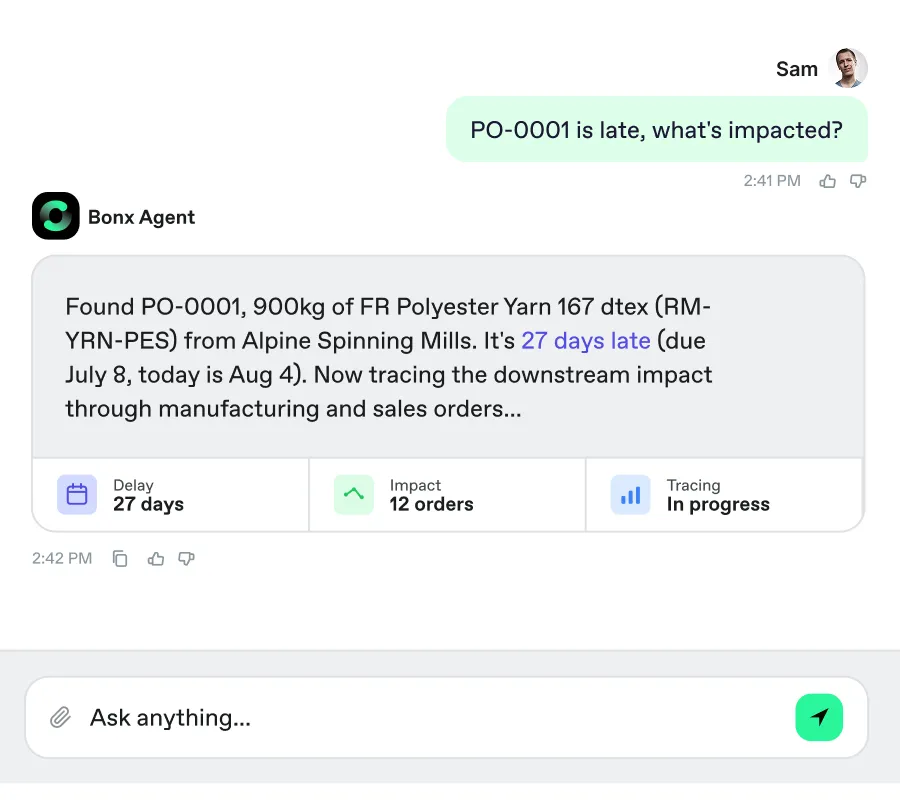
Bonx is the AI-native manufacturing ERP: it runs the operational side of the business — sales orders, purchasing, planning and scheduling (including MRP), production, quality, logistics and stock with lot and serial traceability — and invoices natively while leaving the general ledger to your accounting tool. Deployments are phased and average 10 weeks; workflows are configured by the customer rather than by consultants, and AI agents handle routine decisions and surface exceptions. 80+ manufacturers run on it.
Strength: Fast, consultant-free deployment with floor-first UX and built-in AI agents
Textiles & Apparel features
Manufacturing orders, work instructions and floor declarations · Planning and scheduling against live demand, capacity and materials · Quality checks at receipt, in-process and pre-shipment with batch holds · Multi-site stock with lots, serials and units of measure · Native invoicing with e-invoicing and accounting sync
Used in textiles & apparel byFrench BloomSomethingAddedWed'ze (Decathlon)GreenPodsSo-Le Studio
Sponsored listing · Bonx is a paying sponsor of ERP Research. The numbered editorial ranking is not affected.
Cloud · On-Premise|Best for midsize process manufacturers and distributors
In textiles and apparel manufacturing, Sage X3 fits mid-size producers with international sourcing and multi-entity structures — importers with owned factories, home-textile makers, industrial fabric producers — that need multi-currency financials alongside production. Configured dimension handling can represent size and color variants, and landed cost, intercompany flows, and multi-site inventory serve globally sourced operations well. It is not a fashion-native product: matrix depth, grid order entry, and collection workflows require partner add-ons and configuration that purpose-built apparel systems ship as their core.
Strength: Excellent for process manufacturing (batch, formula, compliance)
Textiles & Apparel features
Multi-currency, multi-entity financials for global sourcing · Landed cost including duty and freight on imports · Dimension handling configurable for size and color variants · Intercompany flows between brands and owned factories · Partner add-ons supplying grid entry and collections
Cloud|Best for fast-growing mid-market companies wanting unified cloud ERP
In textiles and apparel manufacturing, Oracle NetSuite fits growing apparel brands that design in-house, produce through CMT factories abroad, and sell across wholesale, DTC, and marketplaces — businesses whose complexity is channel and entity structure more than plant operations. Matrix items handle size/color variants, outsourced work orders and landed cost track offshore production, and unified financials consolidate channels and subsidiaries cleanly. Matrix items are a data convenience, not a fashion suite: no native cut-plan, CMT settlement, or collection lifecycle tooling, which is why scaling brands add apparel ISVs or eventually migrate.
Strength: True multi-tenant cloud — automatic updates, no upgrades
Textiles & Apparel features
Matrix items for size and color variant SKUs · Outsourced production tracking at CMT factories · Landed cost with duty on imported finished garments · Channel-consolidated financials across wholesale and DTC · E-commerce and marketplace integration for brand sales
Cloud · On-Premise · Hybrid|Best for midsize companies wanting unlimited users and flexible cloud ERP
In textiles and apparel manufacturing, Acumatica suits small to mid-size apparel and soft-goods businesses that want modern cloud ERP economics — consumption-based licensing, open APIs — with apparel capability layered on through marketplace ISVs offering matrix inventory and style management. The core contributes solid distribution, light manufacturing, landed cost, and e-commerce connectivity that fit an importer-producer hybrid well. As with any ISV-dependent fit, the apparel layer is the wager: matrix depth, allocation logic, and seasonal workflows are only as strong and durable as the partner product supplying them.
Strength: Unlimited users — resource-based pricing is unique and cost-effective
Textiles & Apparel features
Marketplace ISVs adding matrix and style management · Consumption-based licensing for seasonal staffing swings · Landed cost on imported fabric and finished goods · E-commerce connectivity for DTC apparel channels · Light manufacturing for cut-and-sew or finishing steps
Cloud · On-Premise|Best for small businesses and startups wanting affordable, modular ERP
In textiles and apparel manufacturing, Odoo fits startups and small brands — cut-and-sew studios, print shops, small garment makers — that need product variants, basic manufacturing, and e-commerce in one inexpensive, open-source stack. Native variant attributes generate size/color combinations without custom development, manufacturing orders cover simple cut-and-sew routings, and the integrated webshop and POS suit direct-selling brands. The apparel depth ends there: no shade-lot fabric control, cut-plan optimization, or wholesale grid-order workflows, so growing labels either build custom modules or graduate to fashion-specific platforms.
Strength: Community edition is free — lowest barrier to entry
Textiles & Apparel features
Variant attributes generating size and color combinations · Manufacturing orders for simple cut-and-sew routings · Integrated webshop and POS for direct-selling brands · Open-source extensibility for custom apparel workflows · Low entry cost for startup labels
Cloud · On-Premise|Best for sMB manufacturers and distributors in 50–500 employee range
In textiles and apparel manufacturing, SYSPRO fits technical-textile and industrial-fabric producers — narrow fabrics, geotextiles, coated materials, workwear — whose operations resemble batch and discrete manufacturing more than fashion retail. Lot traceability across dye and coating batches, BOMs for laminated and converted constructions, quality holds on off-spec rolls, and solid costing serve mills and converters at mid-market cost. Fashion-side capability is minimal by design: no style/color/size matrix, collection management, or grid order entry, which rules it out for brand-led apparel businesses.
Strength: Strong manufacturing and distribution focus at an affordable price
Textiles & Apparel features
Dye-lot and batch traceability across finishing stages · BOMs for coated and laminated fabric constructions · Quality holds on off-specification rolls · Yield and waste costing through converting operations · Mid-market fit for mills and converters
39 ERP vendors evaluated for this guide·Independent — vendors do not pay for ranking or preview it·Reviewed annually with quarterly touch-ups
How we rank these ERPs — our editorial methodology▾
Rankings on this page are editorial, not paid. Vendors do not pay for position, nor do they preview rankings before publication. Every shortlisted system is evaluated on a published 7-pillar framework:
30%Functional depth
20%Total cost of ownership
15%Implementation risk
10%Ecosystem strength
10%Roadmap & AI investment
10%Customer experience
5%Vertical / industry fit
Rankings are reviewed annually with quarterly touch-ups for material changes (new releases, acquisitions, reference drift). Read the full methodology →
Top 10Manufacturing ERP 2026 Edition
Get the Top 10 Manufacturing ERP Report
Free 2026 PDF · 30 pages · the full rankings, pricing benchmarks and RFP checklists for manufacturing buyers.
Used by operations-led manufacturers and distributors such as VersaCourt, On Foot Innovations, and No.1 Raw Materials
Bonx
Bonx
Small and mid-market manufacturers (50–1,000 employees) in process, food & beverage, textile and jewellery production that want an operational ERP live in weeks, configured without consultants
MYOB's flagship mid-market ERP across Australia and New Zealand
Estimate Your Textiles & Apparel ERP Investment
Benchmark against ERP systems used in textiles & apparel and get a 3-year TCO estimate for your company profile.
ERP Cost Estimator
Get an instant cost range based on your company profile
5 – 5,000 active ERP users
Select a company size above to see your estimated cost range and matching vendors.
Key Challenges for Textiles & Apparel
1
Managing SKU proliferation from size, color, fit, and style combinations that create thousands of variants per collection
2
Coordinating global supply chains spanning fabric mills, trim suppliers, CMT factories, and logistics providers across multiple countries
3
Accelerating design-to-delivery timelines to meet fast-fashion and direct-to-consumer demand cycles
4
Tracking fabric yield, consumption, and waste across cutting, sewing, and finishing operations
5
Managing pre-season buying, allocation, and replenishment across wholesale, retail, and e-commerce channels
6
Maintaining compliance with social responsibility, sustainability, and supply chain transparency requirements
7
Handling complex costing across landed cost, duty, quota, and multi-currency sourcing scenarios
Essential ERP Capabilities for Textiles & Apparel
✓
Size-color-style matrix management with grid-based order entry and allocation
✓
Product lifecycle management (PLM) from concept and design through production
✓
Collection and season management with line planning and assortment tools
✓
Cut-make-trim (CMT) costing with fabric yield and consumption tracking
✓
Global sourcing and purchase order management with multi-currency and landed cost
✓
Quality management with AQL inspection, fabric testing, and garment measurement specs
✓
Multi-channel order management across wholesale, retail, and e-commerce
✓
Fabric and trim inventory management with roll tracking and shade-lot matching
✓
Compliance management for sustainability, social responsibility, and trade regulations
✓
Pre-season allocation, in-season replenishment, and markdown optimization
Textiles & Apparel ERP Cost Ranges
SMB
$50,000 – $200,000
10–40 users
Implementation: $40,000 – $150,000
Mid-Market
$200,000 – $750,000
40–150 users
Implementation: $150,000 – $600,000
Enterprise
$800,000 – $4,000,000+
150–2,000+ users
Implementation: $700,000 – $3,500,000+
Implementation Considerations
1
Ensure the ERP natively supports your size-color-style matrix structure — retrofitting a generic ERP for apparel matrix inventory is extremely difficult and error-prone
2
Plan PLM integration (Centric, Gerber YuniquePLM, Lectra) early as design data feeds product master data and BOM structures in ERP
3
Map your sourcing workflows across countries, including landed cost, duty, quota, and trade preference calculations, before ERP configuration
4
Evaluate omnichannel order management requirements including wholesale EDI, retail POS, and e-commerce platform integration needs
5
Define sustainability and supply chain transparency reporting requirements (Higg Index, OEKO-TEX, GOTS) as these increasingly influence ERP data structures
ERP Research case-study library
What 570 verified Manufacturing ERP implementations show
Aggregated from our library of verified customer case studies — real companies, named sources, cross-vendor. See the full data study.
Why do apparel companies need industry-specific ERP?
Apparel ERP must handle size-color-style matrix inventory, seasonal collection management, cut-make-trim costing, fabric yield calculations, global sourcing with landed cost, and multi-channel distribution. Generic ERPs cannot manage the massive SKU proliferation or grid-based workflows fundamental to apparel operations.
What is a size-color matrix and why is it critical?
A size-color matrix (or style grid) is the foundational data structure in apparel ERP that represents all size and color combinations for each style. A single style in 8 sizes and 6 colors creates 48 SKUs. Without native matrix support, inventory management, order entry, and allocation become unmanageable at scale.
How does ERP support global sourcing for apparel?
Apparel ERP manages purchase orders to factories across multiple countries, tracks production milestones (fabric booking, cutting, sewing, packing, shipping), calculates landed cost with duty and freight, manages trade compliance (tariff classification, preferential trade agreements), and provides visibility into offshore WIP and transit inventory.
What is cut-make-trim (CMT) costing?
CMT costing breaks garment production cost into three components: cut (fabric cutting based on marker efficiency and yield), make (sewing labor based on SAM — standard allowed minutes), and trim (buttons, zippers, labels, packaging). ERP calculates product cost by combining CMT with fabric cost, overhead, and landed cost factors.
How important is PLM integration for fashion ERP?
PLM integration is essential for fashion companies. PLM manages the creative and development process (design, tech packs, sampling, fit sessions), and ERP manages production and distribution. Integration ensures product specifications, BOMs, and costing data flow automatically from PLM to ERP without manual re-entry or errors.
Can ERP help with sustainability and supply chain transparency?
Yes. Modern fashion ERPs track supplier certifications (GOTS, OEKO-TEX, Fair Trade), material composition and origin, carbon footprint data, water usage metrics, and chemical compliance. This data supports sustainability reporting, consumer transparency initiatives, and compliance with emerging regulations like the EU Strategy for Sustainable Textiles.
How does ERP handle omnichannel distribution for apparel?
Apparel ERP manages inventory allocation and available-to-promise across wholesale accounts, retail stores, and e-commerce channels. It supports EDI with major retailers, integrates with e-commerce platforms (Shopify, Magento), enables drop-ship and marketplace fulfillment, and provides unified inventory visibility to prevent overselling.
What is the typical implementation timeline for apparel ERP?
Small to mid-size apparel companies can implement in 6–12 months with a focused scope. Mid-market implementations with global sourcing and multi-channel distribution typically take 9–15 months. Enterprise implementations for large fashion brands with multiple brands, regions, and channels can span 12–24 months.