Manufacturing operations demand ERP systems that can handle complex bills of materials, production scheduling, quality management, and shop-floor execution. Whether you run a discrete job shop, a continuous process plant, or a mixed-mode facility, and whether you are a 10-person startup or a global enterprise, the right ERP platform is critical to throughput, compliance, and profitability.
8 Sub-industries covered40+ ERP vendors evaluated6–18 months Typical implementation$97B+ Global ERP market by 2027 (Apps Run The World)Last updated August 2026
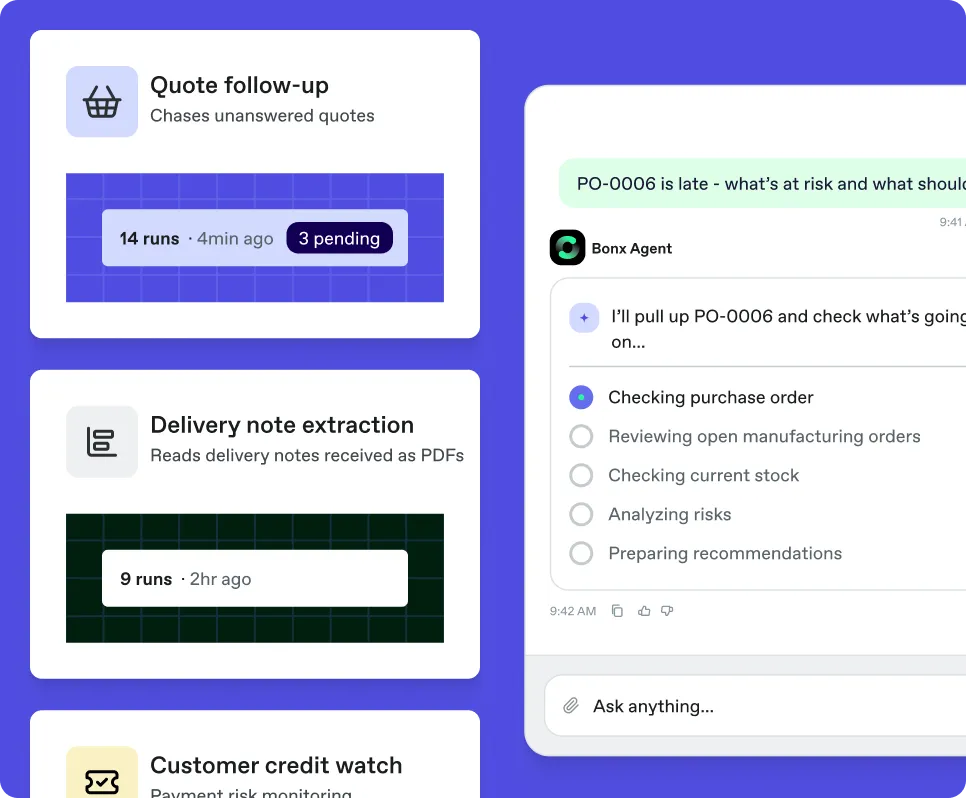
Built for small and mid-market manufacturers, Bonx centralizes and connects your operations so that AI can handle more of the routine. 2x–4x your existing team capacity with manufacturing software your team will actually love.
✓Every manufacturing ERP module you need in one connected system: sales, purchasing, production, quality, logistics, inventory, and invoicing.
✓Connects to anything else in your stack, from tools and systems to machines, hardware, and more.
✓Built-in intelligence gets smarter and more capable of taking on routine work over time.
The best manufacturing ERP systems in 2026 are Oracle NetSuite, SAP S/4HANA Public Cloud, and Epicor Kinetic.Oracle NetSuite is the strongest fit for fast-growing mid-market companies wanting unified cloud ERP; SAP S/4HANA Public Cloud for mid-market and standardised enterprises wanting fast time-to-value; and Epicor Kinetic for discrete and mixed-mode manufacturers. The full ranking below compares 10 systems on pricing, implementation timelines, and manufacturing-specific capabilities, drawing on verified deployments from our benchmark dataset.
Top 10 Manufacturing ERP Systems Compared (2026)
The best manufacturing ERP systems, ranked by fit — with pricing, timelines, product screenshots and action links for every system.
Cloud|Best for fast-growing mid-market companies wanting unified cloud ERP
In manufacturing, NetSuite fits light-discrete makers and product brands that assemble, kit or outsource production rather than run heavy shop floors. Work orders and assemblies, multi-location MRP and WIP costing are native to the suite, and because financials, inventory and commerce share one database, multi-entity manufacturers consolidate without integration work. Deep shop-floor scheduling and MES-grade execution typically come from SuiteApp partners.
Strength: True multi-tenant cloud — automatic updates, no upgrades
Manufacturing features
Work orders, assemblies and WIP for discrete mid-market manufacturers · Multi-location MRP and supply allocation across subsidiaries · Advanced BOM revisions with effective dating · Shop-floor data collection and outsourcing vendor work orders · Standard and average costing with manufacturing variances
Cloud|Best for mid-market and standardised enterprises wanting fast time-to-value
Brings S/4HANA's manufacturing depth to mid-market plants in a fit-to-standard cloud: MRP with finite and infinite capacity, order-based shop-floor confirmations, embedded quality at goods receipt and in-process, and product costing with WIP variance analysis. Discrete and repetitive modes are covered by preconfigured best-practice processes — the trade-off is configuration discipline rather than deep customisation.
Strength: Lowest TCO in the S/4HANA family — no infrastructure or upgrade projects
Manufacturing features
Cloud MRP and production planning with finite/infinite capacity options · Discrete and repetitive manufacturing with order-based shop-floor confirmations · BOM and routing maintenance with engineering-change controlled releases · Embedded quality management on goods receipt and in-process inspection · Product costing with WIP and variance analysis tied to production orders
Cloud · On-Premise · Hybrid|Best for discrete and mixed-mode manufacturers
Built around the job shop and mixed-mode manufacturer: MES-ready shop-floor execution, a product configurator with advanced BOM and routing for make-to-order work, finite scheduling with nested manufacturing orders, and quality (NCR/CAPA) wired directly into production. One of the deepest pure-manufacturing feature sets available to the mid-market.
Strength: Deep manufacturing capabilities (MES, APS, quality)
Manufacturing features
Deep discrete manufacturing with MES-ready shop-floor execution · Advanced BOM, routing and configurator for make-to-order · Scheduling, finite capacity and nested manufacturing orders · Quality, NCR and CAPA tightly linked to production · Job costing, WIP and estimated-vs-actual for custom manufacturers
Cloud|Best for small and mid-market manufacturers (50–1,000 employees) that want an AI-native manufacturing ERP
Bonx is the AI-native manufacturing ERP: it runs the operational side of the business — sales orders, purchasing, planning and scheduling (including MRP), production, quality, logistics and stock with lot and serial traceability — and invoices natively while leaving the general ledger to your accounting tool. Deployments are phased and average 10 weeks; workflows are configured by the customer rather than by consultants, and AI agents handle routine decisions and surface exceptions. 80+ manufacturers run on it.
Strength: Fast, consultant-free deployment with floor-first UX and built-in AI agents
Manufacturing features
Manufacturing orders, work instructions and floor declarations · Planning and scheduling against live demand, capacity and materials · Quality checks at receipt, in-process and pre-shipment with batch holds · Multi-site stock with lots, serials and units of measure · Native invoicing with e-invoicing and accounting sync
Used in manufacturing byFrench BloomSomethingAddedWed'ze (Decathlon)GreenPodsSo-Le Studio
Sponsored listing · Bonx is a paying sponsor of ERP Research. The numbered editorial ranking is not affected.
Cloud · On-Premise · Hybrid|Best for midsize companies wanting unlimited users and flexible cloud ERP
Acumatica's Manufacturing Edition covers discrete, batch-process and project-centric production — BOM and routing, MRP/MPS, rough-cut capacity planning and configurable shop-floor data collection — on consumption-based pricing, so plants can put every operator, scheduler and quality inspector in the system without per-seat cost.
Strength: Unlimited users — resource-based pricing is unique and cost-effective
Manufacturing features
Configurable manufacturing for discrete, process and project production · MRP, MPS and rough-cut capacity for mid-market plants · Engineering workbenches for BOM/routing changes · Production orders with materials, labor and machine time capture · Lot/serial and quality holds through the production lifecycle
Cloud|Best for large enterprises wanting industry-specific cloud ERP
Infor's vertical CloudSuites ship manufacturing processes preconfigured by industry — CloudSuite Industrial for discrete and industrial machinery, Automotive for OEM/tier scheduling and EDI, Food & Beverage and Process for formula, recipe and lot-trace work. Strongest when one of those editions matches your manufacturing mode out of the box.
Strength: Deep industry-specific editions (Industrial, Distribution, Healthcare, etc.)
Manufacturing features
Industry CloudSuite manufacturing for automotive, industrial and aerospace · Configure-to-order and engineer-to-order production models · Advanced planning and scheduling options by vertical suite · Shop-floor integration and quality for regulated industries · Costing and WIP suited to complex discrete manufacturers
Cloud · Hybrid|Best for mid-to-large companies in the Microsoft ecosystem
Dynamics 365 Supply Chain Management spans discrete, process and lean manufacturing — formula and BOM management with engineering change control, production scheduling, and warehouse execution — with analytics and collaboration landing natively in Power BI and Teams. Deeper vertical manufacturing needs are usually met through the ISV ecosystem and a strong implementation partner.
Strength: Seamless integration with Microsoft 365, Teams, and Power BI
Manufacturing features
Dynamics 365 Supply Chain manufacturing for discrete and lean scenarios · Formula/BOM management with engineering change control · Production floor execution and kanban for mixed-mode plants · Resource scheduling and finite capacity on work centres · Manufacturing cost accounting with batch and serial tracking
Cloud|Best for automotive, life sciences, and CPG manufacturers
Purpose-built for automotive suppliers, life-sciences and consumer-products manufacturers: automotive-grade EDI and customer-schedule handling, lean and kanban repetitive production, and validation-ready quality processes. A specialist choice where those verticals' compliance and delivery-performance demands set the bar.
Strength: Deep automotive and life sciences industry templates
Manufacturing features
Automotive and industrial manufacturing with QAD Adaptive ERP · Lean, kanban and repetitive manufacturing practices · EDI-heavy customer schedules driving production · Shop-floor control and genealogy for regulated parts · Costing and WIP for global manufacturing networks
Cloud|Best for large enterprises moving from on-premise Oracle to cloud
Oracle Fusion Cloud for large multi-plant manufacturers running the full Oracle SCM stack: enterprise discrete and process production with the Supply Chain suite, complex BOM/ECO workflows and change orders, MES and shop-floor integrations for high-volume plants, and manufacturing accounting consolidated at global scale.
Strength: Best-in-class financial management and reporting
Manufacturing features
Enterprise discrete and process manufacturing with Oracle Supply Chain suite · Costing, WIP and manufacturing accounting at global scale · Complex BOM/ECO workflows and manufacturing change orders · MES and shop-floor execution integrations for high-volume plants · Quality management with nonconformance and disposition flows
Cloud · On-Premise · Hybrid|Best for asset-intensive industries needing ERP, EAM, and field service in one platform
IFS is strongest in engineer-to-order, project-based and asset-intensive manufacturing — constraint-based shop-order scheduling, complex MRO and component manufacturing loops, and manufacturing, service and asset management in one operational model, which suits producers who also service their installed base.
Strength: Best-in-class field service management (FSM)
Manufacturing features
Engineer-to-order and project manufacturing with IFS · Complex MRO and component manufacturing scenarios · Shop-floor execution and constraint-based scheduling · Quality, asset and manufacturing in one operational model · Project and product costing for custom builds
Cloud|Best for fast-growing, multi-entity technology companies (30–5,000 employees) with lean finance teams replacing a fragmented stack or a legacy ERP
Light is not a shop-floor system — it is the finance and consolidation layer for manufacturing groups running production entities, regional subsidiaries and a holding company on one live ledger. Every posting streams in real time through an open API into MRP, MES and shop-floor systems, and cost and margin per plant surface without waiting on a batch close. Plants keep their operational ERP; Light replaces the fragmented group-finance layer above it. Manufacturers wanting MRP, scheduling or quality in the same system should look elsewhere in this list.
Strength: Multi-entity, multi-book ledger (local GAAP, IFRS, management books) with automatic intercompany elimination on consolidation
Manufacturing features
Group consolidation of production entities, subsidiaries and holding companies on one ledger · Real-time postings streamed through an open API into MRP, MES and shop-floor systems · Cost and margin per plant without waiting on a batch close · Multi-book accounting (local GAAP, IFRS, management books) across countries · Agent-run AP, AR and reconciliation for group finance teams
39 ERP vendors evaluated for this guide·Independent — vendors do not pay for ranking or preview it·Reviewed annually with quarterly touch-ups
How we rank these ERPs — our editorial methodology▾
Rankings on this page are editorial, not paid. Vendors do not pay for position, nor do they preview rankings before publication. Every shortlisted system is evaluated on a published 7-pillar framework:
30%Functional depth
20%Total cost of ownership
15%Implementation risk
10%Ecosystem strength
10%Roadmap & AI investment
10%Customer experience
5%Vertical / industry fit
Rankings are reviewed annually with quarterly touch-ups for material changes (new releases, acquisitions, reference drift). Read the full methodology →
Top 10Manufacturing ERP 2026 Edition
Get the Top 10 Manufacturing ERP Report
Free 2026 PDF · 30 pages · the full rankings, pricing benchmarks and RFP checklists for manufacturing buyers.
Used by operations-led manufacturers and distributors such as VersaCourt, On Foot Innovations, and No.1 Raw Materials
Bonx
Bonx
Small and mid-market manufacturers (50–1,000 employees) in process, food & beverage, textile and jewellery production that want an operational ERP live in weeks, configured without consultants
MYOB's flagship mid-market ERP across Australia and New Zealand
Estimate Your Manufacturing ERP Investment
Benchmark against ERP systems used in manufacturing and get a 3-year TCO estimate for your company profile.
ERP Cost Estimator
Get an instant cost range based on your company profile
5 – 5,000 active ERP users
Select a company size above to see your estimated cost range and matching vendors.
The manufacturing ERP landscape spans purpose-built solutions for small job shops through global enterprise platforms supporting multi-plant, multi-country operations. There is no single best ERP for manufacturing: growing and small manufacturers increasingly choose cloud-native platforms like NetSuite and Acumatica for faster deployment and lower upfront cost, while enterprise and multi-plant operations lean toward SAP S/4HANA, Oracle, or Infor. Modern manufacturing ERP extends beyond traditional MRP II to encompass IoT-driven shop-floor visibility, advanced planning and scheduling (APS), integrated quality management, and end-to-end supply chain orchestration. Selecting the right system requires matching your production methodology — discrete, process, repetitive, or engineer-to-order — with a vendor whose domain expertise aligns to your sub-industry.
Why ERP for Manufacturing is different
Manufacturers face relentless pressure to shorten lead times, reduce scrap, and maintain quality across complex bills of materials. An ERP purpose-built for manufacturing must unify shop-floor scheduling, material requirements planning (MRP), and quality control in a single real-time system. Discrete, process, and mixed-mode production each demand different planning engines. The right ERP eliminates spreadsheet silos, automates compliance documentation, and gives plant managers instant visibility into work-in-progress, capacity utilisation, and supplier performance.
Critical ERP challenges in manufacturing
1Multi-level BOM and routing management across plants
2Real-time shop-floor scheduling and capacity planning
3Quality and compliance traceability (ISO, FDA, AS9100)
What is manufacturing ERP and how does it differ from generic ERP?
Manufacturing ERP includes modules purpose-built for production planning, bill-of-materials management, shop-floor execution, and quality control that generic ERP systems lack. These capabilities support MRP/MRP II logic, capacity planning, work-order tracking, and regulatory compliance workflows specific to manufacturing environments.
Should I choose a cloud or on-premise manufacturing ERP?
Cloud ERP offers faster deployment, lower upfront costs, and automatic updates, making it ideal for small to mid-size manufacturers. On-premise or hybrid deployments may be preferred by large manufacturers with complex integrations, strict data-sovereignty requirements, or shop-floor systems that demand low-latency local connectivity.
How long does a manufacturing ERP implementation typically take?
Small to mid-size manufacturers can go live in 6–12 months with a focused scope. Mid-market implementations with multiple plants typically take 9–15 months. Enterprise-wide, multi-site rollouts for large manufacturers commonly span 12–24 months or longer, especially when legacy system migration and custom integrations are involved.
What is the difference between discrete and process manufacturing ERP?
Discrete manufacturing ERP manages production of distinct, countable items through routings and work orders (e.g., machined parts, assembled products). Process manufacturing ERP handles formula- and recipe-based production with batch tracking, yield management, and potency calculations for industries like chemicals, food, and pharmaceuticals.
Which ERP vendors are strongest for mid-size manufacturers?
Epicor Kinetic, Infor CloudSuite Industrial (SyteLine), SYSPRO, and Acumatica are consistently ranked among the strongest options for mid-size discrete manufacturers. For process manufacturing, Infor CloudSuite Process, BatchMaster, and Sage X3 are leading contenders. QAD and Plex (now part of Rockwell Automation) excel in automotive and high-volume repetitive environments.
How much does a manufacturing ERP system cost?
SMB manufacturers (10–50 users) should budget $75,000–$350,000 for software and implementation. Mid-market deployments (50–250 users) typically range from $250,000 to $1.5 million. Enterprise implementations for large manufacturers with multiple plants can exceed $2–10 million depending on scope, customization, and global rollout requirements.
What role does IoT play in modern manufacturing ERP?
IoT integration enables real-time machine monitoring, automated production counts, predictive maintenance scheduling, and environmental condition tracking directly within the ERP. This connectivity reduces manual data entry, improves OEE visibility, and supports digital twin and Industry 4.0 initiatives by feeding live shop-floor data into planning and analytics modules.
What is the difference between ERP and MES, and do I need both?
ERP operates at the planning and business-transaction level: what to make, when, with what materials, and at what cost. MES operates at the execution level, tracking each production step in real time, collecting machine data, and enforcing process controls on the shop floor. Many mid-market manufacturers with straightforward processes can meet their needs with ERP alone; complex high-mix producers and regulated industries requiring detailed production records typically need both. Some ERPs (Epicor Kinetic, Plex, DELMIAworks) include native MES functionality, while others integrate with standalone MES platforms.
How long does it take to see ROI from a manufacturing ERP?
Most manufacturers achieve positive ROI within 18–30 months of go-live. Companies replacing spreadsheets and disconnected systems tend to see faster returns because the improvement is dramatic, while those replacing a functioning but outdated ERP take longer. The fastest payback typically comes from inventory reduction (carrying-cost savings), improved on-time delivery, reduced scrap and rework, and administrative labor savings from automating manual data entry.
How should manufacturers handle ERP across multiple plants?
The core architectural question is whether to run a single instance serving all plants or separate instances with consolidated reporting. A single instance provides real-time cross-plant visibility, simplified inter-plant transfers, and unified master data, but requires stronger governance. The modern best practice for most manufacturers is a single cloud instance with plant-specific configurations, implemented one plant at a time — plan 3–6 months per mid-size facility — starting with the most representative site so it becomes the template for the rest.
How do we evaluate whether our current ERP needs replacing or upgrading?
Before committing to a replacement, assess whether the shortcomings stem from the software itself or from poor implementation, lack of training, or outdated processes. If the system genuinely cannot support your manufacturing processes — it lacks finite capacity scheduling you need, or cannot handle your regulatory compliance requirements — replacement is warranted. If the core system is capable but poorly utilized, a re-implementation or optimization project may deliver better ROI at lower cost and risk.
Should we hire an independent ERP consultant or manage the selection internally?
For manufacturers without IT leadership experienced in ERP selection, an independent consultant — one not financially tied to any vendor — brings structured evaluation methodology, knowledge of vendor strengths across manufacturing sub-sectors, and negotiation leverage. A full selection engagement typically costs $15,000–$75,000, which is modest against the risk of selecting the wrong system. The internal team must remain actively engaged, however: outsourcing the decision entirely leads to poor outcomes because no consultant understands your business as well as your own team.
How do we maintain data accuracy after ERP go-live?
Data accuracy is an ongoing discipline, not a go-live event. The most critical data for manufacturers is BOMs, routings, inventory balances, and item master records. Implement cycle counting programs rather than annual physical counts, establish data governance policies defining who can create or modify master records, and build validation checks into critical transactions. Many manufacturers see accuracy degrade within 6–12 months of go-live because they treat data management as a project activity — assign permanent data stewards and hold them accountable for data quality metrics.
What regulatory requirements do UK manufacturers need from ERP?
In the UK, manufacturers above the VAT threshold must submit VAT returns digitally through Making Tax Digital (MTD)-compatible software, and the financial module must support UK GAAP (FRS 102) reporting, with multi-GAAP support for subsidiaries of international groups. Manufacturers trading with the EU also need post-Brexit customs capabilities: customs declarations, Rules of Origin documentation, tariff-code management, and landed-cost calculation including duties. Qualifying companies must additionally report energy consumption and emissions under the Streamlined Energy and Carbon Reporting (SECR) framework, which modern ERP supports through energy tracking and carbon accounting modules.
What is the best ERP for small and growing manufacturers?
For small manufacturers (roughly 10-50 users) that prioritise fast deployment and lower upfront cost, NetSuite, Acumatica, and SYSPRO are the most commonly recommended cloud-native picks. Each ships manufacturing-specific modules (BOM, MRP, work orders) without enterprise-level complexity, and NetSuite and Acumatica avoid punitive per-user licensing that penalises headcount growth. Cetec ERP is a strong budget option for very small contract manufacturers and job shops. All typically deploy in 3-6 months at a fraction of the cost of enterprise platforms like SAP S/4HANA or Oracle, and scale as the business grows.
What is the best ERP for food and beverage manufacturing?
Food and beverage manufacturers need process-manufacturing capabilities most generic ERPs lack: recipe and formula management, lot traceability and batch genealogy, FEFO (first-expired, first-out) rotation, allergen and shelf-life control, and HACCP and FSMA compliance. The strongest purpose-built options are Aptean Food & Beverage ERP, BatchMaster, and Sage X3 for mid-market processors, with Infor CloudSuite Food & Beverage and SAP S/4HANA for larger multi-plant operations. NetSuite and Acumatica suit smaller food producers that also carry significant distribution, provided their process and traceability requirements are moderate rather than highly regulated.
What's the difference between accounting software and ERP for manufacturers?
Accounting software handles core financial functions — general ledger, accounts payable, accounts receivable, and financial reporting. ERP extends beyond finance into production planning, inventory, procurement, supply chain, quality control, and shop-floor management. For manufacturers the distinction has narrowed because most modern manufacturing ERP systems include a full accounting module with manufacturing-grade cost accounting (standard, actual, and job costing), work-in-progress (WIP) tracking, and overhead allocation into cost of goods manufactured. If you need only basic bookkeeping, standalone accounting software may suffice; if you need cost accounting tied to BOMs and work orders, you need ERP with manufacturing capabilities.
Which inventory valuation method should manufacturers use?
The best method depends on industry, tax jurisdiction, and production type. FIFO (first in, first out) is standard for food, beverage, and pharmaceutical manufacturers where product expiry matters. LIFO (last in, first out) can offer US tax advantages during inflationary periods but is not permitted under IFRS. Weighted average simplifies accounting for continuous process manufacturers, moving average suits manufacturers with frequent small-batch purchases, and specific identification is used for high-value, low-volume goods. Changing valuation methods after go-live has significant financial and tax implications, so confirm the method with your accountant or auditor before selecting a system.
How much does unplanned downtime actually cost manufacturers, and how does ERP help?
A Fluke Corporation survey published in October 2025 found that 61% of manufacturers experienced unplanned downtime in the previous year, with the sector losing up to $852 million every week to those stoppages, and 48% reporting six to ten downtime incidents per week. World-class Overall Equipment Effectiveness (OEE) is conventionally benchmarked at 85%, while typical plants measure 60–65%. An ERP that cannot capture accurate downtime reason codes, scrap, and cycle-time data at the work centre cannot help close that gap, because the gap never becomes visible in the first place — this is why asset management and shop-floor data capture are core, not optional, manufacturing ERP requirements.
What typically causes manufacturing ERP implementations to run over budget?
Panorama Consulting Group's 2025 ERP Report puts average ERP implementation cost at roughly $450,000 across all industries, with manufacturers usually landing above that average because of MES, CAD/PLM, machine-data, and EDI integration scope. The three most common overrun drivers are underestimated project staffing (38% of projects), scope expansion (35%), and technical or data issues (34%) — all three are controllable at the requirements stage by naming your integrations, data-cleansing scope, and internal project team explicitly before you sign a contract. The same report shows SaaS ERP projects now averaging around 9 months to go live, down from 15 months the prior year, though multi-plant manufacturers with shop-floor integration should plan longer.
What is cost of goods manufactured (COGM) and how does overhead allocation work?
Cost of goods manufactured (COGM) is the total production cost of goods completed in a period: direct materials consumed, plus direct labour, plus allocated manufacturing overhead. Overhead — factory rent, equipment depreciation, utilities, supervision, maintenance — cannot be traced to a specific unit, so accounting software allocates it using a driver such as labour hours, machine hours, activity-based costing, or a percentage of direct cost, and the allocation method materially changes reported product margins. COGM then feeds cost of goods sold (COGS) on the income statement. A manufacturing-grade accounting system automates this roll-up and flags standard-to-actual overhead variances for review each close; generic accounting software leaves finance teams rebuilding the calculation in spreadsheets.
What is work-in-progress (WIP) tracking and why does it matter for manufacturers?
WIP (work-in-progress) is the value of partially completed goods still on the production floor — materials issued and labour or overhead applied, but not yet a finished unit. Manufacturing accounting software needs to calculate WIP automatically from materials consumed, logged labour hours, and applied overhead; post WIP journals that move cost between raw materials, WIP, and finished goods accounts as work orders progress; and expose real-time WIP balances by work order, line, or cost centre so a stalled job doesn't sit invisible on the books. Systems with shop-floor data capture built in — Epicor Kinetic and Infor CloudSuite Industrial are the common examples — post these transactions to the ledger as they happen rather than in a nightly or month-end batch, which is the difference between a WIP balance you can trust mid-month and one you can only trust at close.
Standard costing, actual costing, or job costing — which should a manufacturer use?
The three methods answer different questions and several ERPs support running more than one at once, by product line. Standard costing sets a predetermined cost for materials, labour, and overhead ahead of production, then tracks the variance against actual results — the right fit for repetitive, high-volume discrete manufacturing where the predictability is worth more than per-unit precision. Actual costing captures real costs as incurred, giving precise product-level margins at the cost of more granular data collection, and suits process manufacturers and low-volume operations. Job costing accumulates cost against an individual job or work order and is close to mandatory for engineer-to-order, make-to-order, and project-based manufacturers, where every order has a distinct cost structure that a blended standard cost would obscure. SAP S/4HANA and Dynamics 365 Finance are among the platforms that support all three simultaneously.
What accounting software do small manufacturers use before they need a full ERP?
Below roughly 10–25 employees and a single facility, most small manufacturers run a general ledger tool — QuickBooks Online Plus or Xero — paired with a lightweight manufacturing add-on that handles bill of materials, work orders, and basic MRP: Fishbowl and MRPeasy are the two most common pairings, joined to the ledger via a native connector rather than manual re-entry. The combination covers costed BOMs, simple job costing, and inventory tracking at a fraction of ERP licensing cost, but it caps out fast — multi-entity consolidation, real-time WIP posting, and overhead allocation by activity are where the add-on model breaks down and manufacturers migrate to a true manufacturing ERP such as NetSuite, Acumatica, or SAP Business One.
Talk to an ERP advisor about Manufacturing
Prefer a guided shortlist? Share your requirements and we'll match you with vendors and partners that fit manufacturing.