Cloud ERP for Small Business: 2026 Buyer's Guide
Compare the best cloud ERP for small business — NetSuite, Business Central, Acumatica, Odoo and more, with real pricing bands, cloud vs on-premise, and how to choose. Updated July 2026.

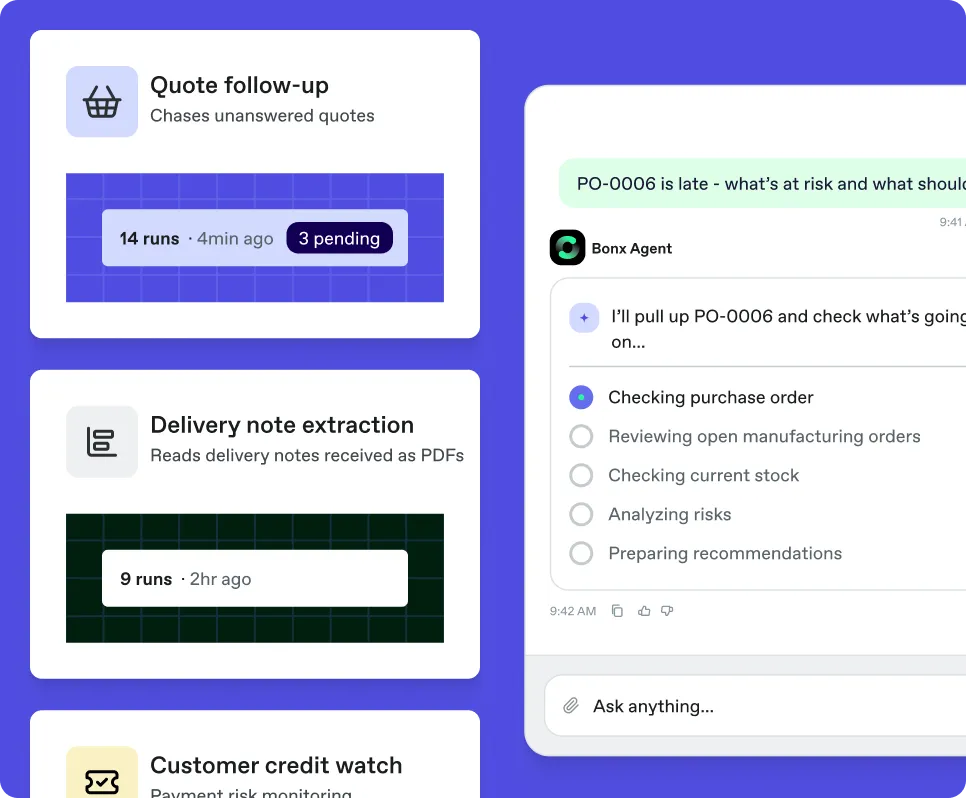
Bonx: AI-native manufacturing ERP for 50–1,000 person teams
Bonx · bonx.com · Cloud
Outgrowing spreadsheets but don't want the cost, complexity, or multi-year rollout of legacy ERP? 2x–4x your existing team's capacity with an ERP that actually takes manual work off your team.
- ✓Everything you need to run your manufacturing operations in one connected system: sales and order management, purchasing, production, quality, inventory management, logistics, and invoicing.
- ✓Connect to anything in your stack, from systems to hardware.
- ✓Let AI handle the routine with a system built with intelligence at its core.
Cloud ERP for small business is web-hosted software that unifies accounting, inventory, sales, and operations in one subscription system — with no servers to run in-house. Entry-level cloud ERP typically costs about $30–$150 per user per month, and most small businesses go live in 8–16 weeks rather than the year-plus timelines associated with legacy on-premise suites.
Updated July 2026. Independent and vendor-neutral — no vendor pays for placement or ranking.
This is an evergreen buyer's guide: what cloud ERP is, how it compares to on-premise systems and to cloud accounting tools, a pricing-and-fit comparison of the leading SMB systems, and a decision framework. For a ranked, hands-on run-through of specific products, see our companion deep-dive on the best cloud ERP for small business.
Cloud vs On-Premise ERP for a Small Business
Nearly all new small-business ERP deployments are cloud-based, and for most SMBs that is the right call. The trade-offs:
| Factor | Cloud ERP (SaaS) | On-premise ERP |
|---|---|---|
| Upfront cost | Low — subscription only | High — licences, servers, setup |
| Ongoing cost | Predictable per-user fee | Maintenance, upgrades, IT staff |
| Implementation time | 8–16 weeks typical | 6–18 months typical |
| Updates | Automatic, included | Manual, often paid projects |
| Access | Anywhere, any device | On-network or via VPN |
| IT burden | Vendor-managed | Your responsibility |
| Best for | Most SMBs and fast-growing firms | Firms with strict data-residency or heavy customisation needs |
On-premise still makes sense for a minority of small businesses with strict regulatory data-residency rules or deeply customised legacy processes. For everyone else, cloud ERP lowers the barrier to entry and removes the infrastructure overhead that used to put ERP out of reach for smaller companies.
Best Cloud ERP for Small Business Compared
The systems below are the cloud ERPs most commonly shortlisted by small and mid-sized businesses. Starting prices are indicative bands for planning — every ERP quote depends on your user count, modules, and data complexity, so always confirm current figures with the vendor.
| Vendor | Starting price (indicative) | Best for | Deployment |
|---|---|---|---|
| Odoo | Free tier; ~$25–$40 per user/mo | Budget-conscious SMBs wanting modular apps | Cloud or on-premise |
| ERPNext | Free self-hosted; ~$50 per user/mo hosted | Open-source-friendly, technical teams | Cloud or on-premise |
| Microsoft Dynamics 365 Business Central | ~$70 per user/mo | Microsoft-centric SMBs needing finance + operations | Cloud or on-premise |
| Sage Intacct | ~$400+/mo (contact for quote) | Finance-led and services firms | Cloud (SaaS) |
| Acumatica | Resource-based, ~$1,000+/mo (contact for quote) | SMBs wanting unlimited users | Cloud or private cloud |
| NetSuite | ~$999/mo + ~$99 per user/mo | Fast-growing SMBs with global ambitions | Cloud (SaaS) |
A few patterns worth noting: open-source options like Odoo and ERPNext offer the lowest entry cost but shift more configuration effort onto you; per-user products such as Business Central scale cleanly with headcount; and resource-based pricing (Acumatica) suits businesses with many light users. NetSuite and Sage Intacct sit at the higher end but bring the deepest financial and multi-entity capabilities.
How Much Does Cloud ERP Cost for a Small Business?
Subscription pricing is only part of the total. Budget for three components:
- Software subscription — commonly $30–$150 per user per month at the entry level, more for advanced editions and financial suites.
- Implementation — typically 0.5×–2× your first-year subscription for a small-business rollout, covering configuration, data migration, and training.
- Add-ons — integrations, extra modules, and premium support.
As a rule of thumb, a small business with 10–25 users should plan for a first-year total in the low tens of thousands of dollars for a mid-range cloud ERP, weighted toward implementation in year one and toward subscription in later years. For a fuller model, see our ERP implementation cost breakdown and our ERP software cost comparison.
Compare ERP vendors side by side
Use our interactive comparison tool to evaluate features, pricing, and fit across leading ERP systems.
How to Choose the Right Cloud ERP
Rather than starting from a vendor list, work through these questions in order — they narrow the field faster than any feature grid:
- What breaks first without ERP? If it is inventory and order accuracy, weight operational depth; if it is month-end and reporting, weight financials.
- How many users, and how heavy? Many light users favour resource-based pricing; a small finance-focused team favours per-user tools.
- Where does your team already work? Microsoft-centric firms gain from Business Central; open-source-comfortable teams from Odoo or ERPNext.
- How fast are you growing? If you expect multiple entities or currencies within two years, choose a system that scales into them without a re-platform.
- What is your realistic budget — including implementation? Be honest about total cost of ownership, not just the subscription line.
Turning those answers into a scored requirements list is the single highest-leverage step in an ERP selection. Our ERP functional requirements guide walks through how to build one.
Frequently Asked Questions
How much does cloud ERP cost for a small business?
Entry-level cloud ERP typically runs about $30–$150 per user per month on subscription. On top of that, budget roughly 0.5×–2× your first-year subscription for implementation, data migration, and training. A small business with 10–25 users should plan for a first-year total in the low tens of thousands of dollars, weighted toward setup costs in year one.
Is cloud or on-premise ERP better for a small business?
For most small businesses, cloud ERP is the better fit: there is no server to buy or maintain, updates are automatic, pricing is predictable per user, and you can be live in weeks rather than months. On-premise ERP only tends to win when strict data-residency rules or heavy, deeply customised legacy processes make vendor hosting impractical.
How long does it take to implement cloud ERP?
Most small-business cloud ERP projects go live in about 8–16 weeks, versus 6–18 months for traditional on-premise suites. Timelines depend mainly on how clean your data is, how many integrations you need, and how much you customise. Keeping the first phase close to standard configuration is the reliable way to hit the shorter end of that range.
Is cloud accounting like QuickBooks or Xero the same as cloud ERP?
No. QuickBooks and Xero are cloud accounting tools focused on bookkeeping, invoicing, and the general ledger. Cloud ERP adds inventory, purchasing, order management, manufacturing, and cross-department reporting on one shared database. Small businesses usually move from accounting software to ERP when spreadsheets bridging those gaps start causing errors and slow month-ends.
What is the best cloud ERP for a small manufacturer?
Small manufacturers need production planning, bills of materials, and inventory control alongside financials. NetSuite and Acumatica are common cloud choices for growing makers, while ERPNext and Odoo offer lower-cost, manufacturing-capable options for lean teams. The right pick depends on production complexity — discrete assembly, process, or make-to-order — and how many concurrent users you need.
Compare the vendors mentioned in this article
See how Microsoft Dynamics 365, Acumatica, Sage Intacct, Odoo stack up side by side.
Vendors Mentioned in This Article
Related Resources
Dynamics 365 vs Acumatica 2026 | UK Comparison & Guide
Dynamics 365 vs Acumatica for UK businesses. Compare pricing in GBP, UK partner ecosystems, MTD compliance, and which mid-market ERP suits your needs.
IndustryERP for Inventory Management: Buyer's Guide (2026)
A vendor-neutral buyer's guide to ERP for inventory management. Compare NetSuite, Acumatica, Cin7, Brightpearl, SAP and Dynamics 365, plus valuation methods, cycle counting, lot traceability and multi-warehouse control. Updated July 2026.
ComparisonERP vs CRM: Differences, Overlap, and Which You Need
ERP vs CRM compared - what each system does, where they overlap, when you need both, and how to decide which to implement first.
ImplementationMicrosoft Dynamics 365 Implementation Guide (2026)
A vendor-neutral guide to Dynamics 365 implementation: the Success by Design phases, realistic timelines, cost drivers, partner selection and the pitfalls to avoid.
ComparisonDynamics 365 VS Acumatica | Acumatica & Dynamics 365 Comparison
Microsoft Dynamics 365 Vs Acumatica. Compare the most popular ERP vendors Dynamics 365 & Acumatica.
Have questions about this topic?
Our ERP experts can help you find the right solution for your business.